
Why Smart Professionals Are Losing Momentum (Without Realizing It)

If you talk to high-performing professionals long enough, a consistent pattern emerges.
They aren’t underqualified. They aren’t disengaged. They aren’t short on opportunity, intelligence, or ambition.
Yet many of them feel unexpectedly stuck.
Not failing — just not moving forward with the clarity, momentum, or confidence they once had.
This isn’t a motivation problem. And it’s not a time-management problem either. What’s happening is more subtle — and more structural.
The Hidden Cost of Cognitive Overload
Over the last five years, the professional environment has changed in ways that disproportionately affect capable, experienced people.
According to the American Psychological Association, cognitive overload occurs when the volume of information and decisions exceeds our ability to process them effectively. High performers are particularly vulnerable because they are often the ones absorbing the most inputs: more responsibilities, more tools, more stakeholders, more expectations.
Meanwhile, research from McKinsey Global Institute shows that the average professional now spends nearly 60% of their workweek managing communications—email, meetings, internal coordination—leaving less than half their time for focused, value-creating work.
Add to that the explosion of platforms, frameworks, dashboards, and AI tools, and the result isn’t efficiency. It’s fragmentation.
Paradoxically, the smarter and more capable someone is, the more likely they are to say yes to complexity.
Why AI Hasn’t Simplified Things (Yet)
AI was supposed to make work easier. In many cases, it has helped — but not in the way people expected.
A 2024 study by Harvard Business School found that while AI tools can increase task efficiency, they often increase decision load by introducing more options, more outputs, and more choices to evaluate. Instead of replacing judgment, AI demands more of it.
Professionals now face questions like:
Which tool is correct?
Which output should I trust?
How do I reconcile conflicting recommendations?
How does this integrate with everything else I’m already doing?
Rather than replacing strategy, AI has made strategy more important — and more difficult to maintain without structure.
Momentum Doesn’t Collapse — It Leaks
One of the most dangerous myths in professional life is that momentum disappears suddenly.
It doesn’t.
Momentum leaks.
It leaks through:
Initiatives that never get fully closed
Tools added without removing others
Campaigns launched without a clear owner or outcome
Content created without a clear role in the revenue cycle
Outreach that isn’t aligned with sales, operations, or customer experience
Over time, capable professionals find themselves busy but brittle — active, yet reactive.
Research from MIT Sloan on organizational effectiveness shows that companies lose momentum not because of lack of ideas, but because of misaligned execution systems. Too many efforts pulling in slightly different directions create drag — even when each effort makes sense in isolation.
Why Doing Less Is Becoming a Competitive Advantage
In economics, there’s a concept called opportunity cost — the cost of what you give up when you choose one path over another.
In modern professional life, the real cost isn’t choosing the wrong thing. It’s choosing too many things.
A study published in Administrative Science Quarterly found that leaders who deliberately reduce priorities — even when those priorities are “good ideas” — outperform peers who attempt to pursue everything simultaneously.
This is why doing less isn’t laziness. It’s leadership.
The professionals regaining momentum right now are not:
posting more
adding more tools
launching more campaigns
attending more meetings
They are subtracting with intention.
They are deciding:
what no longer deserves energy
what can be paused without penalty
what must be integrated rather than layered
what success actually looks like now, not five years ago
What We See Working with Highly Successful Professionals
In our work with senior leaders, founders, and professional services firms, we consistently see the same challenge — regardless of industry.
The problem is not lack of effort. The problem is lack of coherence.
We’ve worked with organizations where:
Sales teams were running outreach disconnected from marketing
Content existed, but had no relationship to pipeline or follow-up
Operations teams were managing systems no one fully understood
Customer experience initiatives lived separately from acquisition strategy
Each department was doing “the right things.” Collectively, the system was exhausting.
When we step into these environments, we don’t start by adding campaigns or tools. We start by mapping what already exists.
Sales, Operations, and Customer Experience Are Not Separate Problems
Research from Gartner shows that B2B buyers now interact across an average of 7–10 touchpoints before making a decision. When messaging, outreach, and follow-up are fragmented across teams, the burden doesn’t fall on the organization — it falls on the buyer.
And when buyers feel friction, confusion, or inconsistency, they disengage.
This is why the core of our work focuses on alignment, not activity.
We help leadership teams:
Clarify positioning so sales isn’t improvising language
Design outreach campaigns that work with existing capacity
Align content with real conversations already happening
Build systems that reduce manual effort rather than add to it
The goal is not to do more. The goal is to make what already exists work harder — together.
Strategy Without Systems Still Creates Work
One of the most common mistakes we see is separating strategy from execution.
Strategy alone doesn’t reduce overwhelm. Execution alone creates burnout.
According to PwC’s Global CEO Survey, over 70% of transformation initiatives fail not because the strategy was wrong, but because the organization lacked the systems to support it.
This is especially true in professional services environments, where:
expertise is distributed
teams are lean
leadership attention is finite
What works is not a massive overhaul, but a campaign-based operating system that respects reality:
current staff
current tools
current client mix
current constraints
When campaigns are designed around what is, rather than what should be, execution becomes lighter — not heavier.
Why Smart Professionals Feel This More Than Others
There’s an uncomfortable truth here.
Highly capable professionals are often the last to admit they need simplification.
They’ve built careers on competence, adaptability, and solving hard problems. Asking for clarity can feel like admitting weakness — even when it’s the opposite.
Psychologists refer to this as competence burden: the more capable you are, the more others rely on you to absorb complexity.
Over time, this erodes decision quality.
A landmark study by Roy Baumeister on decision fatigue showed that as cognitive load increases, even intelligent, disciplined people default to:
avoidance
procrastination
overly safe decisions
reactive behavior
Not because they lack skill — but because their judgment is depleted.
The Shift We’re Seeing Heading Into 2026
As we move into 2026, we’re seeing a clear shift among the most effective leaders and firms.
They are:
prioritizing fewer initiatives
demanding clearer ROI from content and outreach
integrating systems instead of stacking tools
designing campaigns that fit real capacity
valuing judgment over automation
This aligns with broader economic signals. The competitive edge is no longer speed or volume. It’s coherence.
The Real Question for the Year Ahead
As this year begins, the most useful question isn’t:
“What should I add?”
It’s:
What no longer needs to exist?
What can be simplified without loss?
Where is effort being spent without momentum?
What system would make this easier instead of heavier?
Momentum doesn’t come from doing more things well. It comes from doing the right few things — on purpose — and letting everything else go.
And in a world saturated with tools, noise, and advice, clarity itself has become a strategic asset.
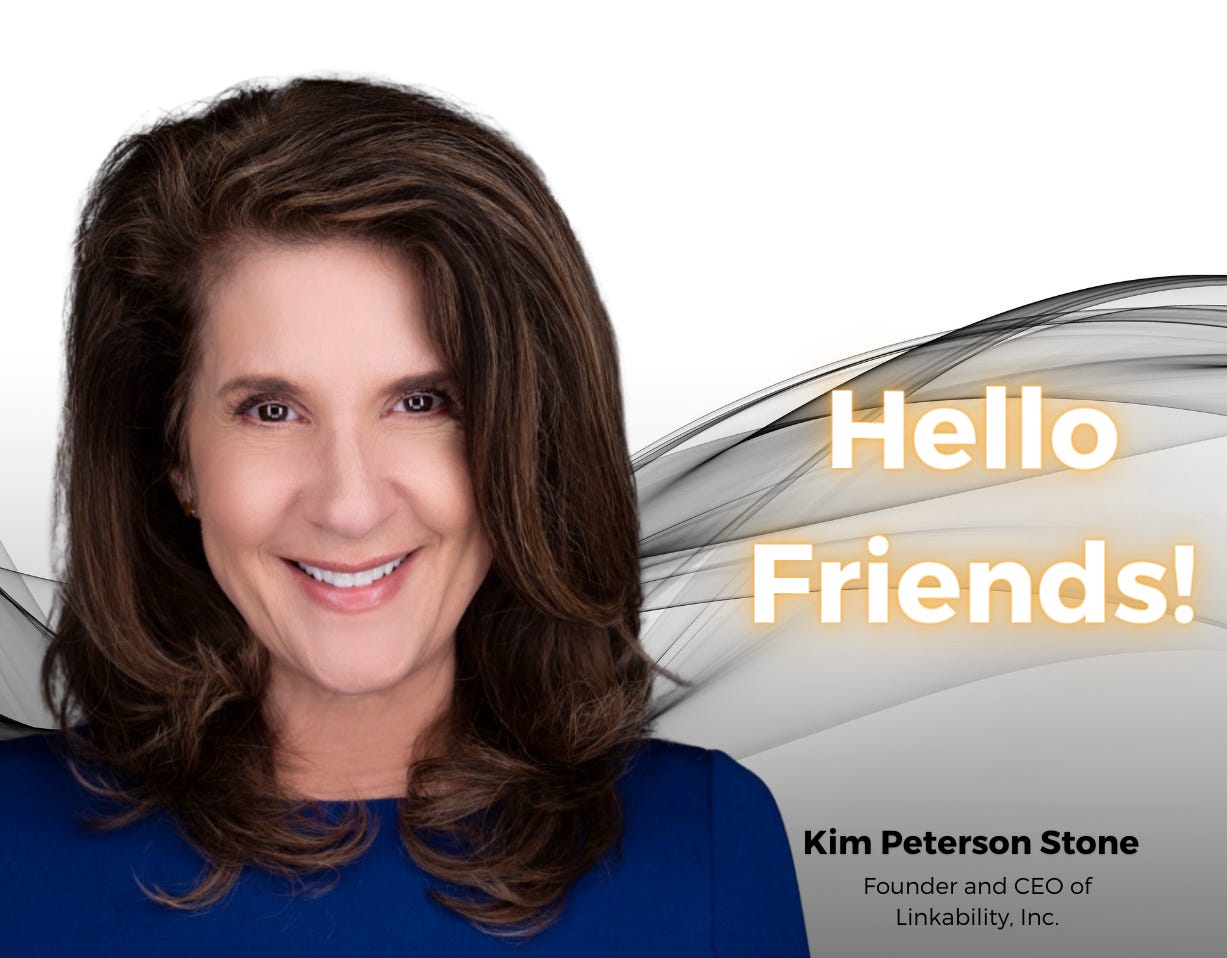
Kim Peterson Stone — three-time founder, keynote speaker, and LinkedIn thought-leader with 225 K+ followers — teaches executives and entrepreneurs how to build unshakable authority, attract targeted opportunities, and future-proof their careers through strategic LinkedIn thought-leadership. As CEO of Linkability.us, she’s helped everyone from startups to Fortune 500 teams work smarter, amplify their influence, and solve their toughest growth challenges.
Ready to become the go-to expert in your field? Let’s talk.